


Search for a replacement tractor lamp and you will find PAR 36, PAR 46 and PAR 56 sitting next to each other on the same shelf, with no explanation of what separates them. Buyers reasonably assume the number is a model code and pick by photograph.
It is not a model code. It is the diameter, and once you know that, most of the confusion around ordering these lamps disappears.
We manufacture PAR 36 LED replacements for agricultural machinery and cross-reference them to original equipment part numbers, so the mis-orders come back to us. The most common one is a bracket that needs a 4-inch lamp and an order for a PAR 36.
The short answer: PAR 36 is a 4.5-inch round sealed-beam format. PAR is Parabolic Aluminized Reflector; 36 is the front diameter counted in eighths of an inch. An LED PAR 36 drops into the same bracket as the incandescent sealed beam it replaces, but only if the depth, the terminals and the system voltage also match.
What the designation encodes
The convention is shared across several lamp families: PAR, R, BR and MR all use eighths of an inch for the front diameter. Divide the number by eight and you have the size in inches.
| Designation | Arithmetic | Front diameter |
|---|---|---|
| PAR 36 | 36 ÷ 8 | 4.5 in (114 mm) |
| PAR 46 | 46 ÷ 8 | 5.75 in (146 mm) |
| PAR 56 | 56 ÷ 8 | 7 in (178 mm) |
| PAR 38 | 38 ÷ 8 | 4.75 in (121 mm) |
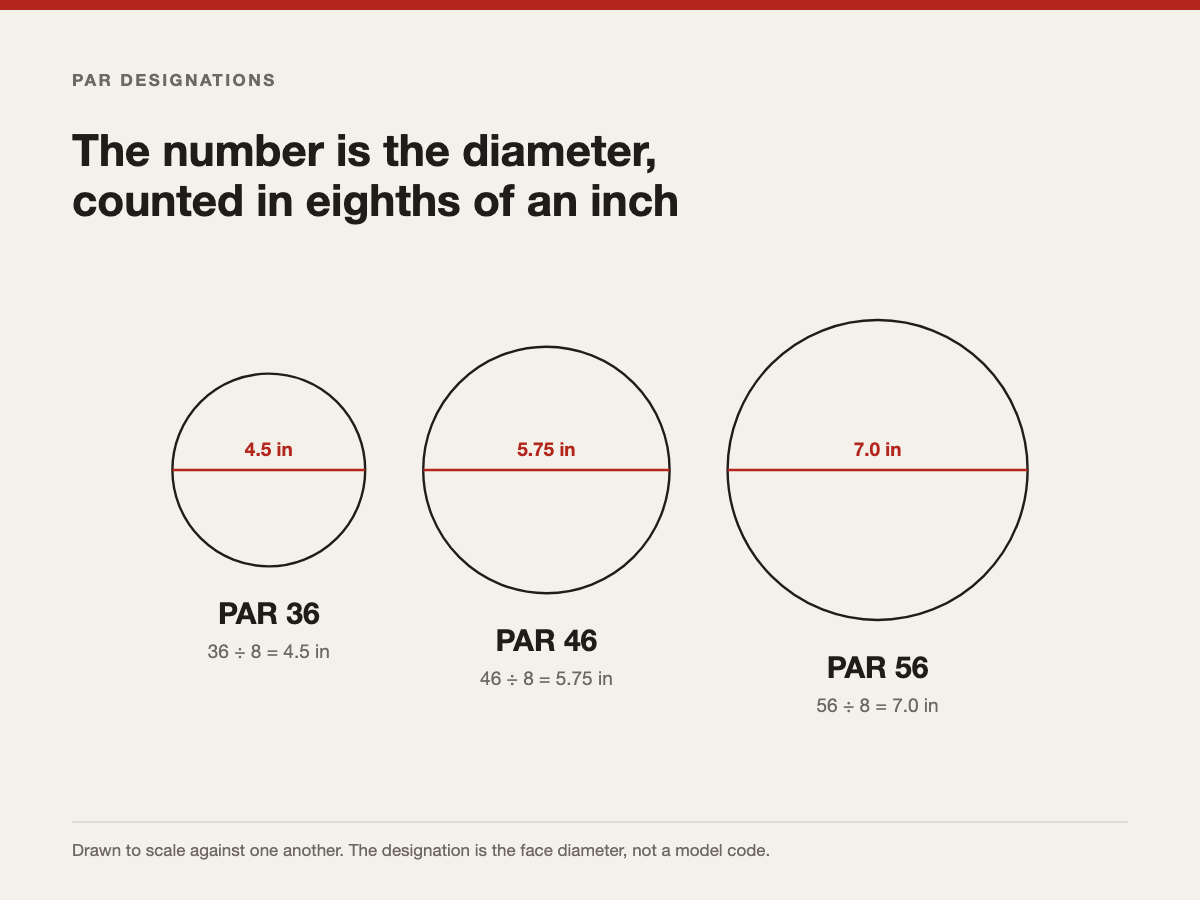
The letters describe the construction, not the application. A parabolic reflector with an aluminized coating and a pressed lens, sealed as one unit, which is why the whole assembly is replaced rather than a bulb inside it. Our sealed beam module entry covers the construction in more detail.
Two consequences follow immediately. A PAR 38 is a different lamp from a PAR 36 despite the similar number, because 4.75 inches is not 4.5 inches. And the number tells you nothing about wattage, beam or voltage, all of which vary freely within a size.
Why a 4-inch PAR 36 does not exist
This is the mis-order we see most.
Round tractor work lamps are commonly sold in 4-inch, 4.5-inch, 5-inch and 7-inch diameters. Only the 4.5-inch one is a PAR 36. The others are their own formats with their own brackets and, usually, their own mounting patterns.
So if you are searching for "4 inch LED tractor lights" or "5 inch round LED lights", the right move is to measure the lamp you are replacing across the front glass, then order by that measurement rather than by the PAR designation. A PAR 36 will not fit a 4-inch aperture, and forcing it usually means drilling a bracket that was fine as it was.
Measure the old lamp before ordering. If it comes out at 4.5 inches you are in PAR 36 territory. If it comes out at anything else, you are not, and no PAR 36 variant will change that.
Sealed beam to LED: what actually changes
The format survives the technology change. A sealed-beam PAR 36 and an LED PAR 36 share the diameter and the mounting, which is what makes the swap attractive on machines still running incandescent lamps.
Three things do change.
Current draw falls, and that is not always neutral. An LED replacement draws a fraction of the original current. On most machines this is pure gain. On machines where a load-sensing circuit or a dash telltale was watching the lamp current, the lower draw can read as a failed lamp.
Heat moves. An incandescent sealed beam sheds most of its energy forward as radiated heat, which is what keeps its lens clear of snow and ice. An LED sends its heat backwards into the housing, so the lens sits close to ambient. On snow-clearing machines that turns into a specification decision rather than a nuisance, which is why heated lenses exist for that duty.
The beam is now a design choice. A sealed beam's pattern came from the reflector geometry and there was one of it. LED replacements are available as flood, spot, trapezoid and combination patterns in the same 4.5-inch body, which means the replacement decision now includes a choice the original did not offer.
The voltage question, answered honestly
Our PAR 36 lamps are 9–32 V DC. One lamp covers both 12 V and 24 V machines, which is why we do not sell separate 12 V and 24 V variants; the multi-volt input entry explains the range.
That range does not reach down to 6 volts.
A number of older tractors, including a good many of the machines people most want to modernise, run 6 V systems, often with positive earth. These lamps will not work on them. There is no variant of ours that will. Converting the machine to 12 V negative earth is a real and common project, but it is a machine decision that has to happen before the lamp decision, not a wiring trick at the lamp end.
We would rather say this plainly than sell a lamp that goes back. If your machine is 6 volts, check the battery and the generator before ordering anything.
Our PAR 36 lamps and what they cross-reference
All four are 4.5 inches across the front. Depth behind the mounting face differs, and that is the dimension that decides whether a lamp clears the structure behind the bracket.
| Model | Power | Lumens | Depth | Beam | Original equipment numbers |
|---|---|---|---|---|---|
| YW-4017-18 | 18 W | 1,440 | Not stated | Flood / Spot / Trapezoid | RE336111 |
| YW-4017-18N | 18 W | 1,440 | Not stated | Flood / Flashing | None published |
| YW-4017-24 | 24 W | 2,200 | 1.5 in | Spot / Flood, Hi-Lo | AR48723, AR85263, AR85264, AR93335, RE10962, RE10963, RE19081, RE19082, TL3025 |
| WL3005 | 24 W | 2,200 | 1.5 in | Spot / Flood, with red tail lamp | AR21737, AR21739, AR77324, ELJ50-0015, TL3005 |
The original equipment numbers are cross-references, not claims of origin. They tell you which lamp our part is dimensionally and functionally equivalent to, which is how most of our customers find the right part; they have the old number and not the machine's build sheet.
Note the last row. WL3005 combines a white work lamp and a red tail lamp in one PAR 36 body, which is a function the original sealed beam on those machines also carried. Replacing it with a plain white PAR 36 leaves the machine without a tail lamp.
That is not only an inconvenience. State lighting codes require the rear lamp separately: Minnesota Statutes 169.55 subdivision 2 requires a self-propelled implement of husbandry to carry "at least one lamp displaying a red light to the rear," and Ohio Revised Code 4513.111 requires red reflectors visible to the rear on older agricultural tractors alongside amber flashing lamps. If the lamp you are replacing was carrying the rear function, the replacement has to carry it too.
What has to match before "direct fit" is true
Four things, in the order they cause problems:
Front diameter. 4.5 inches, measured across the glass. This is the one the PAR number guarantees.
Depth behind the mounting face. Two of our four lamps need 1.5 inches. A shallow recess that took a sealed beam may not take a finned LED housing.
Terminals. Screw terminals, spade terminals and pigtails are not interchangeable without an adapter, and the original lamp's arrangement is not implied by the PAR size.
Function. Single filament, Hi-Lo, or work lamp plus tail lamp. Fitting a single-function lamp where the machine expects two loses the second function silently.
Get those four right and the lamp goes in with the original bracket. Get the first one right and the other three wrong, and it still will not fit.
Frequently asked questions
What does PAR 36 mean in lighting?
PAR stands for Parabolic Aluminized Reflector, describing a sealed lamp built as a parabolic reflector with an aluminized coating and a pressed front lens. The 36 is the front diameter counted in eighths of an inch, so a PAR 36 measures 36 ÷ 8 = 4.5 inches across the face.
What is the size of a PAR 36 light bulb?
4.5 inches, or about 114 mm, across the front glass. Depth behind the mounting face is not fixed by the designation and varies by lamp: two of our four PAR 36 lamps need 1.5 inches of clearance behind the bracket.
Can I use a PAR 36 LED on a 6 volt tractor?
Not ours. Our PAR 36 lamps are specified 9–32 V DC, which covers 12 V and 24 V systems and stops short of 6 V. Machines still on 6 volts, particularly with positive earth, need to be converted to 12 V before any of these lamps will work.
Is there a 4 inch PAR 36 LED?
No. The 36 in PAR 36 is the diameter, so every PAR 36 is 4.5 inches. If the lamp you are replacing measures 4 inches, it belongs to a different round lamp family and should be ordered by its measured diameter instead.
Measure first, then order
Take the diameter across the front glass of the lamp you are replacing, check the depth available behind the bracket, note the terminal type, and confirm whether the original carried a second function such as a tail lamp. Those four answers turn a PAR 36 order into a part number.
If you have the original equipment number, that is faster still: send it with your enquiry and we will match it against the cross-reference above. Browse the PAR 36 tractor lamp range, or the wider tractor and equipment headlight range if the measurement came out at something other than 4.5 inches.
Next: John Deere Lamp Fitment: OE Cross-Reference by Position and Series maps the original equipment numbers to lamp positions across the John Deere range.
---


